Pyrometry Detectors
Standard single-color pyrometers measure infrared energy at a single wavelength, making them vulnerable to accuracy loss when dust, smoke, steam, or changing surface finishes alter the thermal signal.
An InGaAs-over-InGaAs sandwich photodiode overcomes these limitations by enabling two-color (ratio) pyrometry along a single, coaxial optical path.
By vertically stacking two Indium Gallium Arsenide detectors directly on top of one another, the assembly captures two distinct short-wave infrared (SWIR) bands simultaneously from the exact same target spot without needing external beam splitters or moving filter wheels.
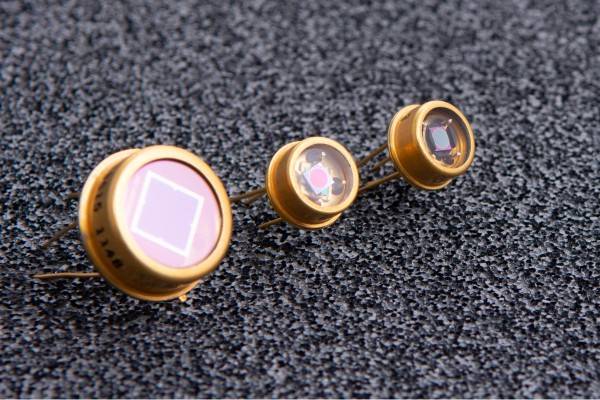
Download our datasheet & Introduction to InGaAs Over InGaAs Ratio Pyrometry white paper, below to learn more.
This stacked semiconductor architecture acts as its own natural optical filter. Incoming thermal radiation first strikes the top standard InGaAs photodiode, which absorbs shorter-wavelength photons—typically up to a 1.7 µm cutoff—and converts them into an electrical signal. Because semiconductors are transparent to wavelengths longer than their bandgap cutoff, longer infrared waves pass cleanly through the top detector with minimal loss. Directly underneath, an extended-wavelength InGaAs detector captures these transmitted photons (typically 1.7 µm to 2.2 µm) and generates a second independent signal. The pyrometer’s electronics then divide the two signals, using the predictable shift in energy ratio across wavelengths to calculate an exact surface temperature.
For demanding industrial and scientific environments, this vertical design delivers critical performance advantages. Because smoke, dirty viewing windows, and shifting material emissivity reduce radiation across both bands equally, the ratio remains constant and the temperature reading stays accurate without frequent recalibration. Furthermore, ratio detection accurately measures targets smaller than the optical spot size—such as thin wires or molten metal streams—while vertical stacking eliminates the parallax errors common in side-by-side sensors. Ideal for metallurgy, semiconductor processing, glass manufacturing, and high-temperature furnaces, InGaAs sandwich photodiodes provide dependable thermal monitoring where traditional sensors fail.
Features
- Multiple lens and window options
- Thermoelectric cooling options
- Large active areas
- Low dark current
Applications
- Ratio Pyrometry
- Remote temperature sensing
Datasheet
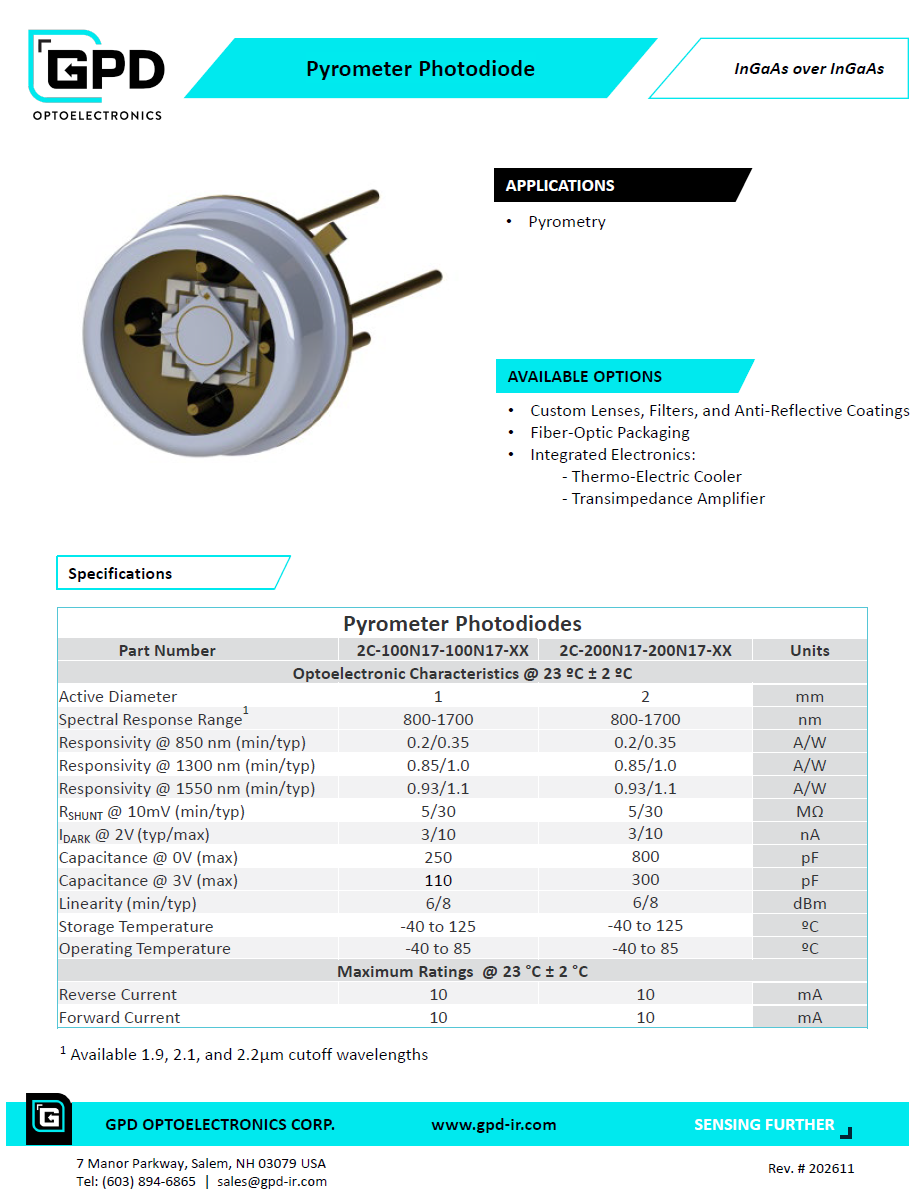
Datasheet
