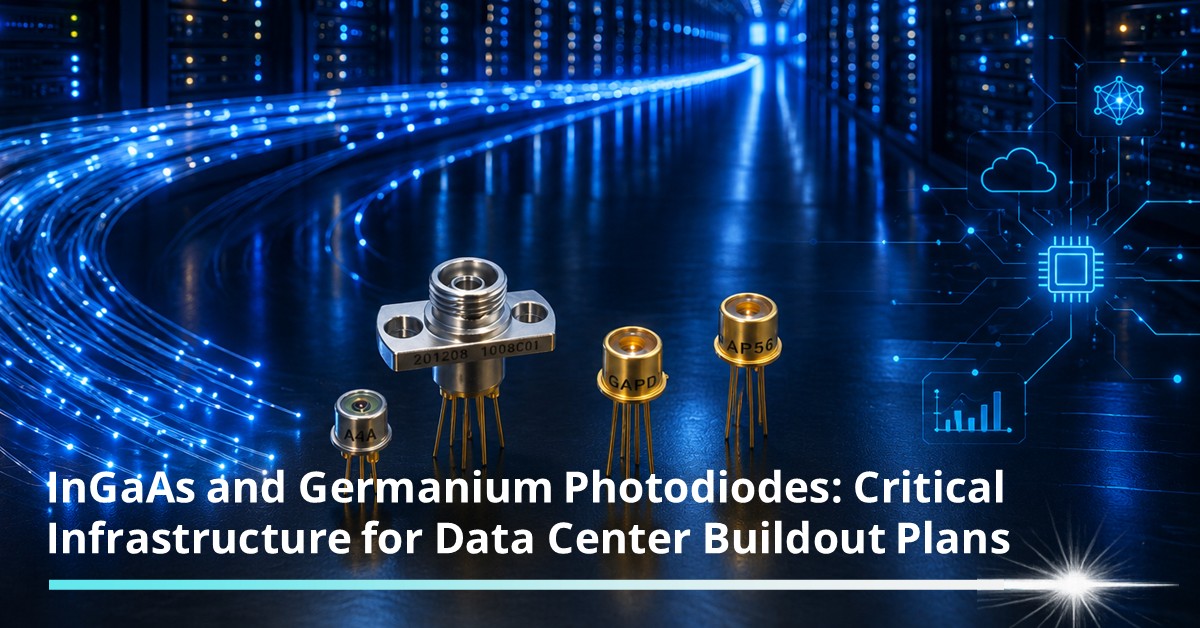
InGaAs and Germanium Photodiodes: Critical Infrastructure for Data Center Buildout Plans
Why Silicon Can’t Keep Up with High-Speed Optical Networks
The AI boom is becoming a physical infrastructure boom. Across the U.S., hyperscalers are building massive new data-center capacity, with OpenAI’s planned $500 billion Stargate initiative and record North American supply growth showing that AI infrastructure is moving from concept to construction.
To feed massive GPU clusters and high-density server racks, modern facilities require massive data pipelines.
For decades, copper wiring handled this infrastructure. However, copper has hit a physical brick wall. High-frequency electrical signals degrade quickly over copper wire, generating extreme heat and wasting valuable energy.
To solve this latency and power bottleneck, the tech industry has migrated toward optical computing infrastructure. Light pulses transmitted through fiber-optic cables have in many cases replaced electrons moving through copper. Yet, as networks scale, AI infrastructure bottlenecks are extending far beyond raw compute power and basic fiber interconnections. Delivering fast, clean, and efficient data requires high-fidelity conversion points across the entire network fabric.
At the absolute center of this optical revolution sit photodiodes. Unlike integrated chips, discrete photodiodes are standalone, specialized components engineered exclusively to convert optical light back into electrical data with maximum efficiency. As data centers scale up to 800G, 1.6T, and beyond, Germanium (Ge) and Indium Gallium Arsenide (InGaAs) photodiodes have evolved into indispensable building blocks for the future of digital infrastructure.
The Why Now: The Scaling Crisis at 800G and 1.6T
The urgency driving alternative semiconductor materials comes down to an immediate commercial timeline. The 800G network architecture is actively entering deployment, while 1.6T is rapidly moving through standardization, interoperability testing, and early productization.
As optical infrastructure becomes more central to AI data centers, having reliable photodetection becomes more important across monitoring, test, alignment, sensing, and specialized receiver applications. It is no longer just about the destination receiver at the end of a fiber link; it is about embedding ultra-precise photodetection into every layer of the optical pathway to maintain network health, optimize laser alignment, and test signal integrity at unprecedented frequencies.
The Fundamental Physics Problem: Why Silicon Fails
Silicon is the undisputed king of the computing world. It forms the foundation of our processors, memory chips, and standard electronic circuits. However, silicon possesses a fundamental limitation that renders it useless for high-speed fiber-optic communication: its bandgap energy.
Fiber-optic communication relies heavily on the near-infrared (NIR) spectrum—specifically wavelengths around 1310 nm and 1550 nm. Engineers utilize these wavelengths because they experience minimal signal loss and scattering as they travel through glass fiber cables. Unfortunately, silicon is physically transparent to wavelengths longer than 1100 nm. NIR light passes right through a silicon chip without hitting anything.
To convert incoming light pulses back into electrical data that a server’s processor can understand, optical transceivers require alternative materials with narrower bandgaps. This is where Germanium and InGaAs step in. Both materials excel at absorbing NIR light, acting as the ultra-fast “eyes” of modern optical networks.
Germanium Photodiodes: Cost-Effective Powerhouse for Shorter Links
Germanium photodiodes have long been a reliable workhorse in near-infrared detection. When manufactured as an isolated, standalone component, Germanium benefits from decades of mature manufacturing techniques. In data center buildouts, Germanium photodiodes are highly critical for specific tiers of the network:
- Exceptional Linearity and Range: Germanium sensors provide excellent linearity and a broad spectral response covering 800 nm to 1700 nm. This allows them to cleanly capture data across multiple transmission bands.
- Cost-Efficient Scaling: Building out massive data center architectures requires thousands of optical transceiver modules. Because Germanium is cheaper to process as a raw material compared to complex compound semiconductors, Ge photodiodes offer an incredibly cost-effective option for high-volume deployments where extreme signal sensitivity isn’t the primary constraint.
While Germanium exhibits higher background electronic noise (dark current) and lower shunt resistance than its counterparts, it is heavily relied upon in high-signal environments where cost per optical channel must be kept to a minimum.
InGaAs Photodiodes: Unleashing Ultra-High Speeds and Precision
Where Germanium prioritizes cost-efficiency, Indium Gallium Arsenide (InGaAs) delivers raw, uncompromised performance. InGaAs is a III-V compound semiconductor recognized as the gold standard for high-speed light detection. AI training workloads require massive datasets to zip between thousands of interconnected GPUs with near-zero latency. InGaAs photodiodes cater perfectly to these demands due to several key performance factors:
- Extreme Velocity: InGaAs features exceptionally high electron mobility. When a light pulse strikes an InGaAs photodiode, it generates electrons that move through the material at blazing speeds. Advanced configurations can easily handle frequencies up to 25 GHz. This speed is mandatory for supporting next-generation 800G and 1.6T optical architectures.
- Near-Zero Noise (High Signal Integrity): InGaAs chips feature significantly higher shunt resistance and lower dark current compared to Germanium. This means they generate almost no background electrical noise when no light is present. This pristine signal-to-noise ratio allows the photodiode to cleanly interpret ultra-fast, faint light signals over longer distances. Consequently, it reduces data packet drops and saves the massive amounts of compute energy usually wasted on retransmitting lost data.
Mapping Out the Data Center Architecture and Our Offerings
Modern data center design dictates exactly where these two materials deploy across the infrastructure fabric, presenting clear opportunities for specialized photodetection portfolios:
- Short-Reach Interconnects (Up to 500m): Inside the server chassis and across adjacent racks, Germanium photodiodes are often deployed in short-reach transceivers. They offer the necessary broad spectral range and cost structure to support millions of local optical lanes economically.
- Spine-Leaf Switches and Data Center Interconnects (2km to 10km+): For high-throughput aggregate switches and links connecting separate data center buildings, InGaAs photodiodes take charge. Their superior sensitivity, low noise, and ultra-high frequency response ensure that massive data pipelines remain pristine over longer distances without signal degradation.
- Optical Monitoring, Test, and Instrumentation: Beyond the primary data receivers, our specialized photodetector offerings for optical communications address the critical ancillary markets that keep these pipelines active. Our component line supports inline power monitoring to prevent signal drift, automated alignment sensors for co-packaged optics, and ultra-low-noise diodes designed specifically for high-speed bit-error-rate testing (BERT) and optical time-domain reflectometry (OTDR). As 1.6T moves through standardization, our components offer the reliability and testing accuracy needed to validate early-stage productization and interoperability.
The Bottom Line
The global data center buildout is no longer just about adding more processors; it is about building faster highways to connect them. As the industry scales past the physical limitations of copper, optical networking has transitioned from a luxury to an absolute necessity.
Germanium and InGaAs photodiodes provide the critical bridge between the worlds of light and electricity. Germanium delivers the economic viability and robust range needed for high-volume, cost-conscious links, while InGaAs provides the raw speed and pristine signal quality demanded by cutting-edge AI clusters. By anchoring our photodetector offerings at the center of optical monitoring, testing, alignment, and reception, we ensure that hyperscalers have the foundational tools required to deliver clean, fast, and efficient data for the next generation of computing.
Ready to Specify Your Next Photodetector?
Choosing between Germanium and InGaAs, or narrowing down to the right part number, comes down to matching wavelength, speed, and signal requirements to your system design. GPD Optoelectronics’ interactive Photodetector Selector walks through these questions and maps your answers to the detector types and parameters that fit your application. For a deeper look at specifications and system-level trade-offs, the Photodetector Buyer’s Guide covers the full selection process from specs to system performance.