GPD Optoelectronics Announces Launch of Multi-Cell Photoreceiver Development Kit Ahead of Space Tech Expo Europe 2025
Supporting Advanced Optical Systems
GPD Optoelectronics Corp., a leading designer and manufacturer of high-performance infrared and optical detection solutions, today announced the commercial release of its Multi-Cell Photoreceiver (MCPR) Development Kit, a platform built to accelerate engineering, evaluation, and deployment of multi-cell photodiode architectures like quad- or octo-cell photodiodes for space, defense, metrology, and free-space optical systems.
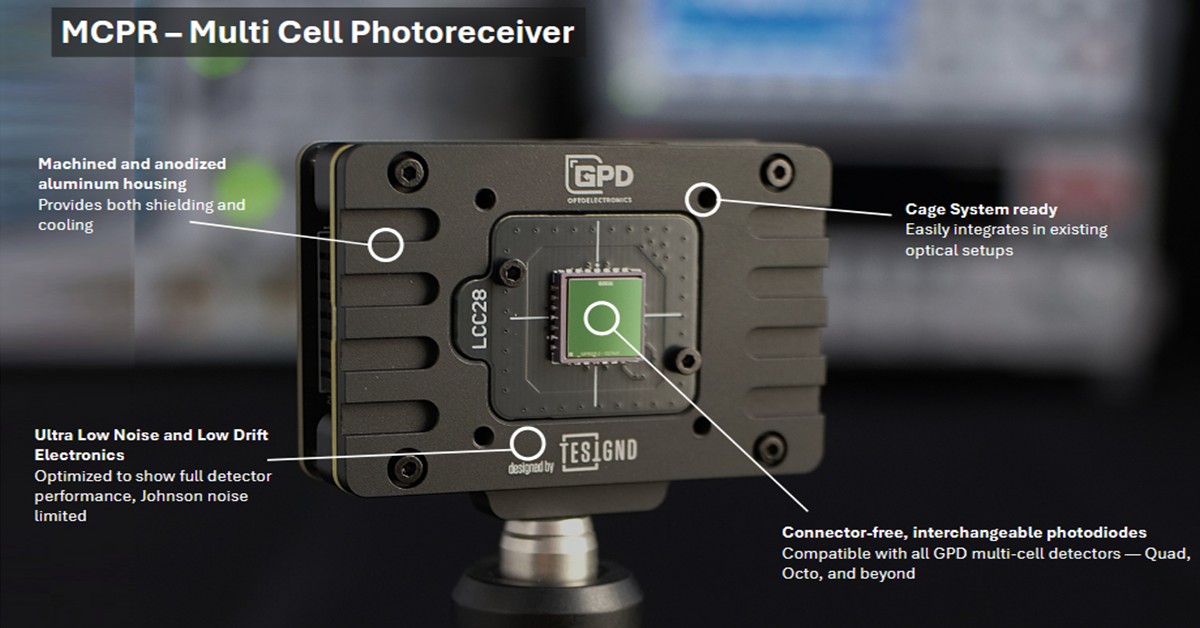
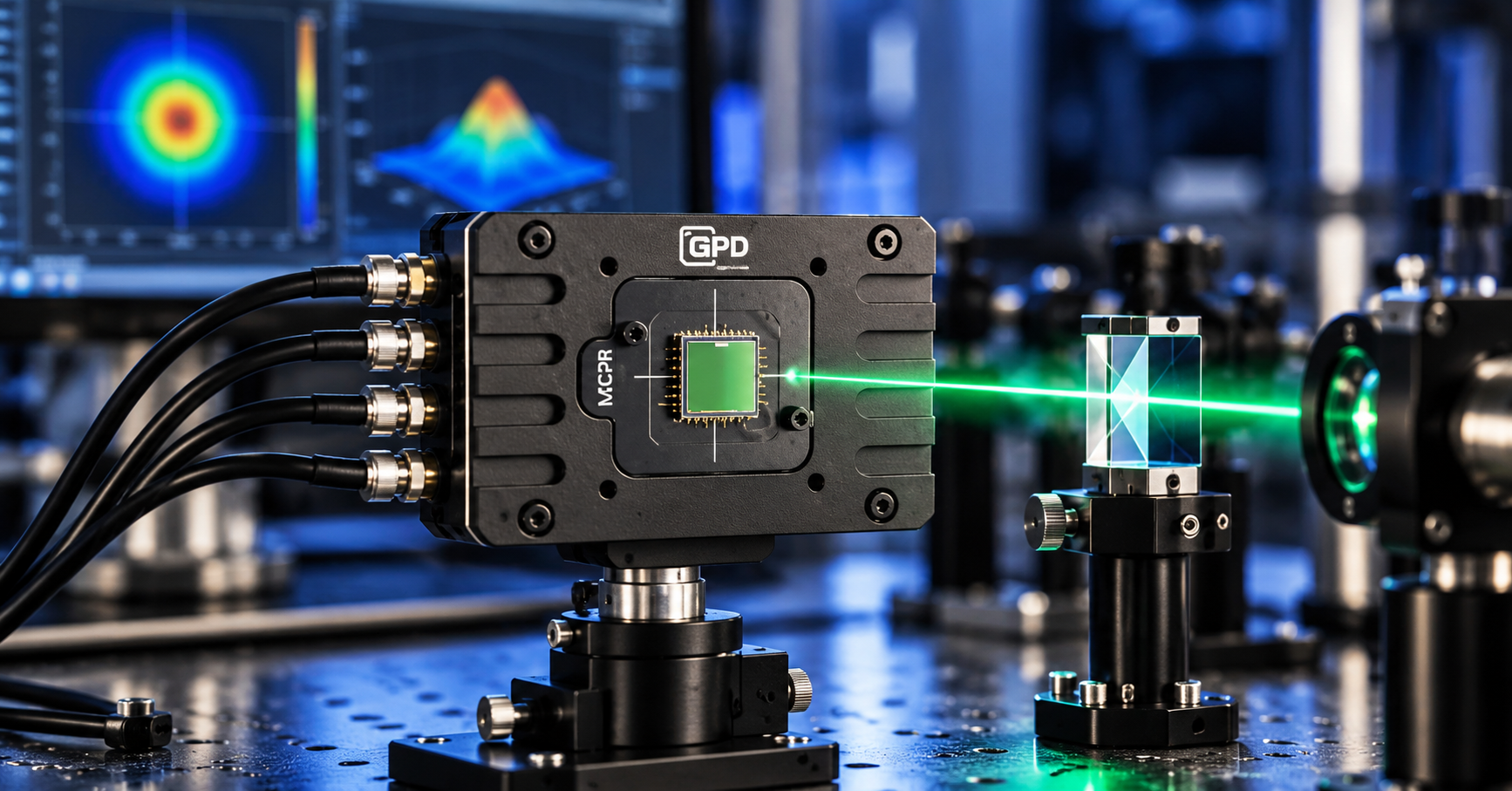
The MCPR kit combines 8-channel ultra-low-noise transimpedance electronics, connector-free high-speed photodiode connectivity, and a shielded, thermally stable precision-machined housing to deliver true detector-level performance right out of the box. With cage-system compatibility, plug-and-play integration, and open signal access, the system provides engineers with immediate access to a wide range of multi-cell detector behaviors for beam steering, polarization analysis, multi-wavelength detection, and high-resolution optical tracking.
“This launch closes a major gap in the shift toward next-generation systems and solutions,” said Stuart David, Senior Vice President of Sales and Marketing. “Teams shouldn’t spend months building and evaluating electronics before they even get to data. The MCPR lets you characterize detector dynamics, evaluate noise floors, and validate system performance in minutes, not quarters.”
Built for Fast Application Deployment
With the MCPR kit, engineering teams can rapidly:
- Characterize beam profiles, steering, and position sensing
- Evaluate detector linearity, crosstalk, and system noise
- Run multi-channel photodiodes for tracking and metrology
- Drop into existing optical benches with cage-system mounts
- Integrate into existing systems and field prototypes through open electronics access
First Public Demo: Space Tech Expo Europe 2025
The MCPR will be first publicly showcased at:
Space Tech Expo Europe 2025
Booth ZZ20
Bremen, Germany
Nov 18–20, 2025
Engineering and program teams can schedule a private demonstration and application review.
Book a meeting for your demo & technical discussion
Getting precision right at the detector level unlocks mission success downstream. Bring your optical challenge — and see how the MCPR accelerates your path to flight- or field-ready performance.
About GPD Optoelectronics
Founded in 1973 and headquartered in Salem, New Hampshire, GPD Optoelectronics Corp. is a leading U.S. manufacturer of InGaAs and Germanium photodiodes, position sensing devices, and custom optical detectors. GPD’s products serve aerospace, defense, telecommunications, industrial, and research applications worldwide. With a proven track record in both custom and commercial off-the-shelf (COTS) solutions, GPD is dedicated to delivering precision, reliability, and innovation under its brand promise: Sensing Further
Recent News
 https://www.gpd-ir.com/wp-content/uploads/2026/10/How-the-MCPR-Development-Kit-Accelerates-Photodiode-System-Design.png
907
1734
GPD Optoelectronics
https://www.gpd-ir.com/wp-content/uploads/2025/12/GPD-Logo-Transparent.png
GPD Optoelectronics2026-10-27 13:54:542026-11-18 11:30:54How the MCPR Development Kit Accelerates Photodiode System Design
 https://www.gpd-ir.com/wp-content/uploads/2026/10/Selecting-a-Photodiode-Built-to-Outlast-Your-Aerospace-Mission-Main-Graphic.png
907
1734
GPD Optoelectronics
https://www.gpd-ir.com/wp-content/uploads/2025/12/GPD-Logo-Transparent.png
GPD Optoelectronics2026-10-09 10:30:142026-11-17 14:01:09Selecting a Photodiode Built to Outlast Your Aerospace Mission
 https://www.gpd-ir.com/wp-content/uploads/2026/09/Introducing-What-is-a-Photodiode-A-Complete-Guide-Blog-Post-Graphic.png
907
1733
GPD Optoelectronics
https://www.gpd-ir.com/wp-content/uploads/2025/12/GPD-Logo-Transparent.png
GPD Optoelectronics2026-09-18 16:51:422026-11-18 11:31:48Introducing What is a Photodiode: A Complete Guide
 https://www.gpd-ir.com/wp-content/uploads/2026/08/Picking-the-Right-Photodiode-for-Your-Wavelength-Range.jpg
628
1200
GPD Optoelectronics
https://www.gpd-ir.com/wp-content/uploads/2025/12/GPD-Logo-Transparent.png
GPD Optoelectronics2026-08-28 11:46:432026-11-18 11:33:48Picking the Right Photodiode for Your Wavelength Range

