The Ultimate Guide to InGaAs Photodiodes
Infrared detection is at the center of modern photonics. Fiber optic communications, LiDAR, spectroscopy, semiconductor inspection, aerospace sensing, medical instrumentation, and industrial monitoring all depend on detectors that can measure light beyond the visible spectrum.
For many of these systems, the most important detector material is Indium Gallium Arsenide, commonly known as InGaAs.
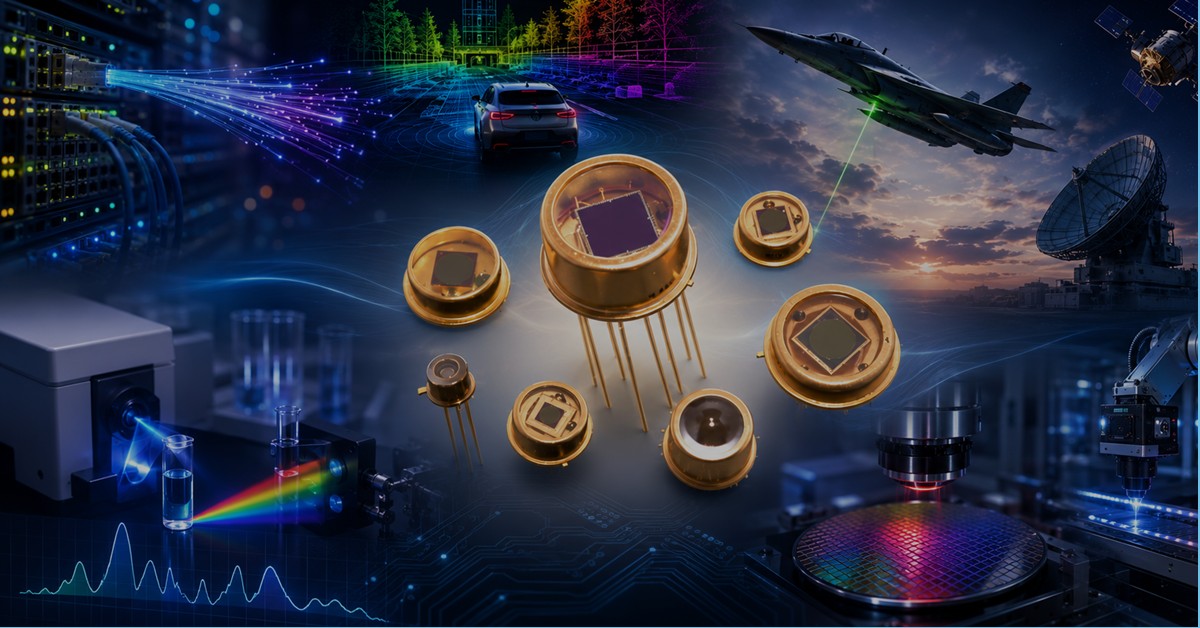
InGaAs photodiodes convert near-infrared and short-wave infrared light into electrical current with high sensitivity, fast response, and strong performance at the telecommunications wavelengths of 1310 nm and 1550 nm. They fill a critical gap between silicon detectors, which perform well in the visible and near-infrared, and mid-infrared detector technologies used at longer wavelengths.
GPD Optoelectronics manufactures photodiodes and photodetector solutions for demanding NIR and SWIR applications, including standard InGaAs, extended InGaAs, high-speed InGaAs, APDs, quadrant detectors, specialty detectors, and custom packaging options.
What Is an InGaAs Photodiode?
An InGaAs photodiode is a semiconductor detector that converts infrared photons into an electrical signal. The device uses an Indium Gallium Arsenide absorption region matched to near-infrared and SWIR wavelengths that silicon cannot efficiently detect. When light enters the active region, absorbed photons generate electron-hole pairs. The device separates those charges and produces a photocurrent proportional to the incoming optical power.
For engineers, the practical value is straightforward: InGaAs provides usable sensitivity at wavelengths that are central to optical communication, sensing, metrology, and spectroscopy. Standard InGaAs devices typically cover approximately 0.9 to 1.7 microns, making them useful for 1064 nm lasers as well as 1310 nm and 1550 nm telecom systems. Extended InGaAs variants push sensitivity further into the SWIR, enabling applications that require detection above the standard device cutoff.
A photodiode can be used as a discrete component, integrated into a receiver, packaged with fiber coupling, or built into a more specialized assembly. The right configuration depends on the optical path, expected power levels, bandwidth, environmental conditions, and system integration requirements.
Why Silicon Falls Short in Infrared Systems
Silicon photodiodes work well below roughly 1000 nm. They are reliable, inexpensive, and widely used for visible-light detection in applications such as barcode scanning, laser monitoring, and general optical measurement. But silicon responsivity falls sharply as wavelength approaches and exceeds that threshold, making it poorly suited for many infrared systems.
That limitation matters because several of the most important optical wavelengths are beyond silicon’s effective range. Fiber optic communication systems commonly operate around 1310 nm and 1550 nm, the bands that support low-loss transmission through optical fiber. Many eye-safer LiDAR and range-finding systems also operate at longer near-infrared wavelengths. Spectroscopy and SWIR sensing frequently depend on absorption features that silicon cannot capture efficiently.
InGaAs photodiodes address that gap directly. They provide strong responsivity across the NIR and SWIR region, enabling accurate measurement where silicon would produce weak signals or unusable noise performance.
Standard, Extended, and High-Speed InGaAs Photodiodes
InGaAs detectors are not a single product category. Standard, extended, and high-speed variants are each optimized for different performance requirements, and selecting the wrong type for an application can add unnecessary cost or compromise performance.
Standard InGaAs photodiodes are the workhorse option. They typically provide strong performance from roughly 900 nm to 1700 nm and are commonly selected for telecom, optical power monitoring, laser sensing, and general NIR detection. They offer a balanced combination of sensitivity, dark current, speed, packaging flexibility, and cost.
Extended InGaAs photodiodes are designed for systems that need detection beyond the standard cutoff wavelength. That broader spectral response supports spectroscopy, chemical sensing, gas detection, environmental monitoring, and other SWIR applications. The tradeoff is that extended wavelength response increases dark current and noise, so the application must justify the added range.
High-speed InGaAs photodiodes are optimized for fast optical signal detection. In these devices, active area, capacitance, package design, and bias conditions all become especially important. Smaller active areas generally support faster response and higher bandwidth, while larger detectors simplify optical alignment but may limit speed.
Key Specifications Engineers Should Evaluate
Wavelength range is the starting point, not the final criterion. A detector that appears suitable on wavelength alone may fail if it has the wrong bandwidth, active area, dark current, noise characteristics, or package geometry. These are the specifications that determine the system’s real performance.
Responsivity measures how efficiently the detector converts optical power into electrical current, expressed in amps per watt. Higher responsivity improves signal level and can reduce the need for downstream amplification.
Dark current is the current that flows when no light is present. It is one of the most important limits in low-light detection because it contributes noise and reduces the usable signal-to-noise ratio. Dark current typically increases with temperature, active area, and extended wavelength response.
Bandwidth determines how quickly the detector responds to changes in light intensity. Telecom receivers, pulsed laser systems, LiDAR, and high-speed instrumentation require faster photodiodes with lower capacitance and carefully designed packages.
The active area affects both light collection and speed. Larger detectors simplify alignment and capture more light but carry higher capacitance. Smaller detectors are faster and have lower capacitance but require tighter optical alignment.
Noise Equivalent Power, or NEP, describes the minimum optical power that can be detected above the noise floor. Lower NEP is better, particularly for spectroscopy, scientific instrumentation, and photon-starved sensing applications.
InGaAs PIN Photodiodes vs. Avalanche Photodiodes
The two most common InGaAs detector architectures are PIN photodiodes and avalanche photodiodes (APDs), and the right choice depends on the full system’s signal levels and noise budget, not the detector alone.
A PIN photodiode is the natural starting point for most applications. It offers low noise, stable operation, good linearity, and relatively simple biasing. For telecom, power monitoring, spectroscopy, and most industrial applications, a PIN detector provides the best balance of performance and integration complexity.
An APD adds internal gain through avalanche multiplication. That gain can significantly improve detection in very low-light conditions, making APDs useful for long-range sensing, LiDAR, photon-starved measurement, and certain optical communication systems. The detector amplifies the signal before external electronics introduce additional noise.
APDs also require more careful system design. They typically operate at higher bias voltages, have greater temperature sensitivity, and introduce multiplication noise. Bias stability, temperature compensation, and receiver circuit design all become more critical. Engineers evaluating APDs should model the full signal chain before committing to the architecture.
Major Applications of InGaAs Photodiodes
InGaAs photodiodes are used wherever systems need reliable NIR or SWIR detection. Their strongest markets span telecommunications, LiDAR, spectroscopy, semiconductor inspection, aerospace and defense, and scientific instrumentation.
 In Optical Communications, InGaAs detectors are essential at 1310 nm and 1550 nm. They are used in optical receivers, transceivers, coherent communication systems, DWDM networks, test equipment, and power monitoring devices.
In LiDAR and range finding, InGaAs photodiodes detect reflected laser energy from distant targets. Fast response, high sensitivity, and performance at longer near-infrared wavelengths make them well-suited for Aerospace, Defense, Industrial Automation, mapping, and eye-safe sensing architectures.
InGaAs detectors measure absorption features in the short-wave infrared (SWIR) region, supporting Bio-Sensing workflows such as biomolecule analysis, pathogen detection, and cellular activity monitoring. The same capability extends to chemical analysis, pharmaceutical inspection, gas detection, environmental monitoring, and laboratory instrumentation.
In Semiconductors and Industrial Inspection, InGaAs detectors are used for wafer analysis, laser monitoring, process control, machine vision, and non-contact measurement. Wavelength, speed, package geometry, and environmental durability are often the dominant selection criteria in these applications.
Quadrant and Multi-Cell InGaAs Detectors
Some systems need to know not only how much light is present, but where that light is falling. Quadrant Photodiodes solve this by dividing the active region into four independent segments. By comparing the current in each quadrant, the system can calculate the beam position and movement with high precision.
Quadrant detectors are common in laser alignment, optical tracking, beam steering, motion stabilization, free-space optical communication, aerospace guidance, and precision instrumentation. InGaAs quadrant detectors extend these position-sensing capabilities into the near-infrared and SWIR bands.
Multi-Cell Detector architectures support more advanced position feedback, larger dynamic range, and specialized optical alignment tasks. These devices are especially valuable when precise beam centering or tracking is required in demanding environments.
Low Polarization-Dependent Loss InGaAs Photodiodes
In fiber-coupled systems, the polarization state can vary over time. If a detector’s response shifts with polarization, the measured signal fluctuates even when the actual optical power remains constant. For precision measurement systems, that variation introduces an error that cannot be distinguished from a real signal change.
Low Polarization-Dependent Loss InGaAs Photodiodes are designed to minimize this effect by maintaining stable responsivity across changing polarization states. The result is improved measurement repeatability and reduced uncertainty in systems where polarization cannot be tightly controlled.
These devices are most relevant in fiber-optic sensing, telecom test equipment, optical metrology, and other applications where small signal variations matter.
Packaging, Fiber Coupling, and Cooling
Custom Packaging is often a meaningful advantage for OEMs. Optical, mechanical, electrical, and thermal constraints vary significantly across systems, and a standard package that requires substantial adaptation can introduce more risk than a purpose-built solution.
A detector chip with strong intrinsic performance can underperform in the real system if the package introduces misalignment, parasitic capacitance, thermal instability, or environmental vulnerability. Packaging is not secondary to detector selection; in many designs, it is equally important.
Common options include TO cans, ceramic submounts, leadless chip carriers, surface-mount packages, hermetic packages, and fiber-coupled assemblies. Fiber-Coupled Packaging is particularly important when the optical signal originates from or enters a fiber. The package must preserve alignment, minimize insertion loss, and support stable long-term performance.
Thermoelectric Cooling reduces dark current and thermal noise, improving performance in low-light applications, extended-wavelength detection, and precision spectroscopy. It adds size, cost, power consumption, and integration complexity, so it should only be specified when the system noise budget requires it.
How to Choose the Right InGaAs Photodiode
The right detector fits the full application. Begin by defining the wavelength range, expected optical power levels, required speed, operating temperature range, package constraints, and whether the system is fiber-coupled or free-space. Those parameters narrow the field significantly before any datasheet comparison begins.
- For telecom systems, bandwidth, capacitance, responsivity at 1310 nm or 1550 nm, and package parasitics are typically the dominant criteria.
- For spectroscopy, low noise, wavelength range, linearity, active area, and cooling options generally take priority.
- For LiDAR and range finding, speed, internal gain, dynamic range, and optical alignment drive the decision.
- For position sensing, segmentation geometry and channel-to-channel matching are essential.
Once the application requirements are clear, the comparison across detector type, active area, dark current, capacitance, bandwidth, responsivity, package format, operating voltage, thermal requirements, and long-term availability should be straightforward. The remaining judgment is whether a standard product is sufficient or whether custom packaging or detector geometry reduces system-level risk.
Our Photodetector Selector and Photodetector Buyer’s Guide are practical starting points for comparing detector types and narrowing options based on application requirements.
Why Work with GPD Optoelectronics
Photodetector selection involves tradeoffs that rarely surface in a single specification table. A detector must align with the optics, electronics, mechanical design, environmental conditions, production requirements, and long-term reliability needs of the complete system.
GPD Optoelectronics brings in-house photodiode and packaging expertise to those decisions. The company supports a broad range of InGaAs, germanium, multi-cell, APD, specialty, and packaging solutions for aerospace, defense, telecom, industrial, and scientific applications.
For OEMs and engineering teams, that combination of detector knowledge and packaging flexibility reduces development risk. Engineers can select or adapt a solution around actual optical and electrical requirements rather than forcing a system design around a generic component.
Conclusion
InGaAs photodiodes are essential components in modern infrared detection. They provide the sensitivity, speed, and wavelength coverage required for systems operating beyond the useful range of silicon, particularly at key NIR and SWIR wavelengths such as 1064 nm, 1310 nm, and 1550 nm.
Choosing the right detector means balancing responsivity, dark current, bandwidth, active area, capacitance, noise, package type, cooling, and application-specific constraints. PIN photodiodes, APDs, high-speed detectors, quadrant detectors, low-PDL devices, and custom-packaged assemblies each solve distinct problems in the infrared signal chain.
GPD Optoelectronics has the detector portfolio and packaging experience to support that selection process, from standard catalog products to fully customized solutions tailored to the system’s requirements.
Resources
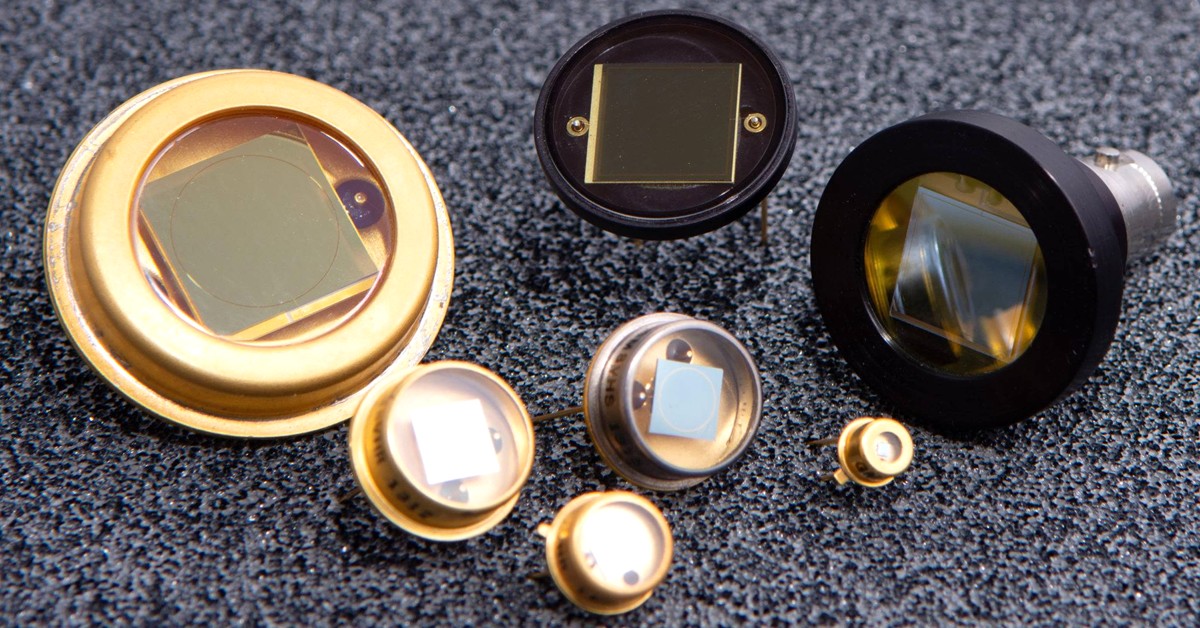
Our Buyer’s Guide
Choosing the right photodetector is critical for achieving accurate, reliable optical measurements. This guide explores key selection factors including wavelength range, responsivity, speed, noise, and packaging to help engineers match detector performance to specific applications across telecom, industrial, and scientific systems.
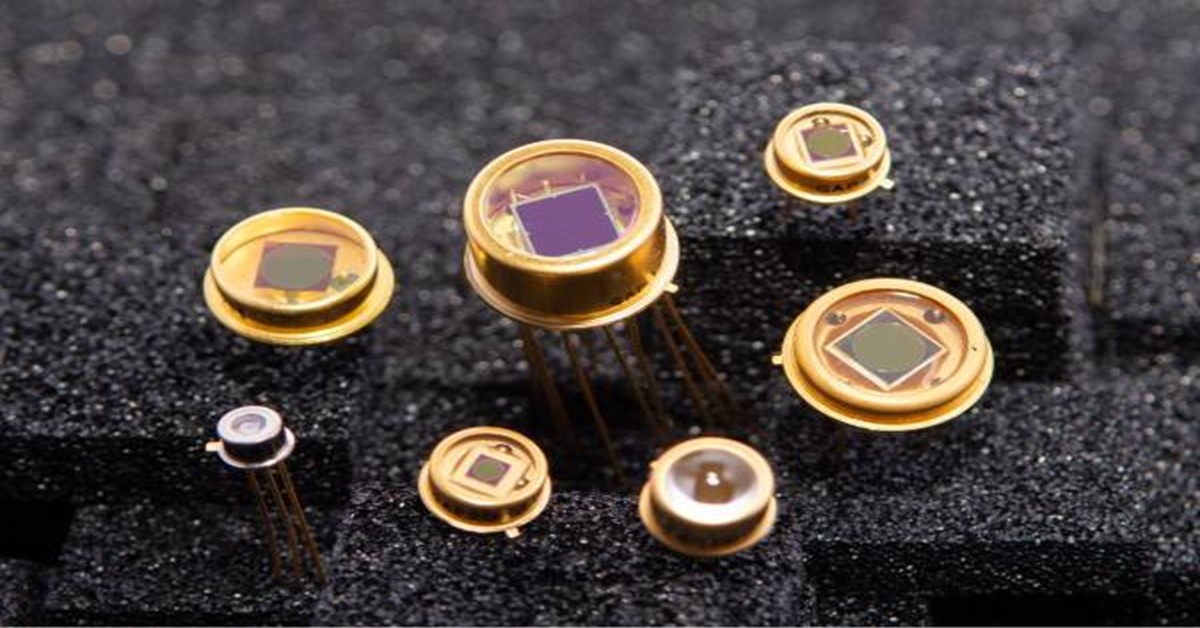
Our Photodetector Selector
Answer four questions about your application — wavelength range, response speed, signal strength, and beam tracking — and our Photodector Selector points you to the detector type best suited for your system. From there, a parameter reference table breaks down the datasheet values that matter most, including responsivity, dark current, bandwidth, and active area, so you understand not just which detector to choose but why. A trade-off section rounds it out by walking through the competing properties that every engineer has to balance when optimizing for performance, cost, and form factor.