What is a Photodiode? A Complete Guide
A Deep Dive into Photodiode Types, Specifications, and Applications
A photodiode is a semiconductor device that converts light into an electrical current. It sits at the center of nearly every optical sensing system in use today, from fiber optic receivers to medical pulse oximeters to industrial laser rangefinders. Engineers who understand how a photodiode works can make faster, more confident decisions when selecting a detector for a new design.

This guide covers the operating principles behind photodiodes, the major device types on the market, the specifications that matter most during selection, the material systems that set wavelength range, and the application areas where photodiodes are used.
This photodiode deep dive is a starting point for engineers new to photodetector selection and a reference for anyone who wants a refresher on the fundamentals.
Key Specifications to Understand
Selecting a photodiode comes down to matching a handful of specifications to the application’s requirements.
- Responsivity describes how much electrical current a photodiode produces per unit of optical power, expressed in amps per watt. Responsivity varies with wavelength, so a datasheet curve showing responsivity across the full spectral range is more useful than a single peak number.
- Dark current is the small current a photodiode produces even without light. It sets a noise floor and directly limits the smallest signal a system can reliably detect. Dark current rises with temperature and reverse-bias voltage, so both factors matter in circuit design.
- Noise equivalent power (NEP) expresses the optical power required to produce a signal equal to the device’s own noise, at a given bandwidth. NEP is the specification to check when a design needs to detect very weak optical signals.
- Bandwidth and rise time describe how quickly a photodiode responds to a changing light signal. These two specifications are related mathematically, and either one can be used to determine whether a device can keep up with a given modulation rate or pulse width.
- Quantum efficiency is the percentage of incident photons that produce a usable electron-hole pair. It is closely tied to responsivity and to the material system used in the device.
- Junction capacitance affects both speed and noise in the receiver circuit. Lower capacitance generally supports faster response times and lower noise, and it typically comes from a narrower active area or a wider depletion region.
- Active area affects how easily the detector aligns with an incoming beam or fiber, and it trades off against capacitance in the design. A larger active area simplifies optical alignment and collects more stray light, while a smaller active area lowers capacitance and improves speed; the choice depends on whether the application prioritizes alignment ease or raw bandwidth.
- Breakdown voltage matters most for avalanche photodiodes, where the operating bias sits close to the avalanche breakdown point. Stable, temperature-compensated bias circuitry is essential for consistent APD performance over a product’s operating temperature range.
How Photodiodes Work
A photodiode is built around a p-n junction, the same basic structure found in a standard diode. Light striking the junction generates electron-hole pairs through the photoelectric effect. Under the right bias conditions, this process produces a measurable electrical current proportional to the amount of incoming light.
Photodiodes typically operate in one of two modes.
- Photovoltaic mode applies no external bias. The device generates a small voltage on its own, similar to a solar cell. This mode produces very low noise and suits precision, low-light measurements where speed is not the priority.
- Photoconductive mode applies a reverse bias across the junction. The reverse bias widens the depletion region, lowering junction capacitance and speeding up the device’s response time. This mode is the standard choice for high-speed applications such as fiber optic communication, where response times in the nanosecond or picosecond range are required.
The depletion region itself deserves attention. It is the junction area depleted of free charge carriers, where most of the light-generated current originates. A wider depletion region improves quantum efficiency at longer wavelengths and improves speed, but at the cost of a slightly higher operating voltage requirement.
The photodiode itself is only half of a working detection circuit. Most designs pair the device with a transimpedance amplifier, a circuit that converts the photodiode’s small output current into a usable voltage. The amplifier’s feedback resistor and bandwidth must match the photodiode’s capacitance, since a mismatch often causes ringing, noise, and reduced effective speed in an otherwise well-chosen detector. A stable, low-noise bias supply matters just as much, particularly in photoconductive mode and especially for avalanche photodiodes, where small shifts in reverse bias translate into large gain shifts.
Types of Photodiodes
Several photodiode architectures exist, each suited to a different balance of speed, sensitivity, and cost.
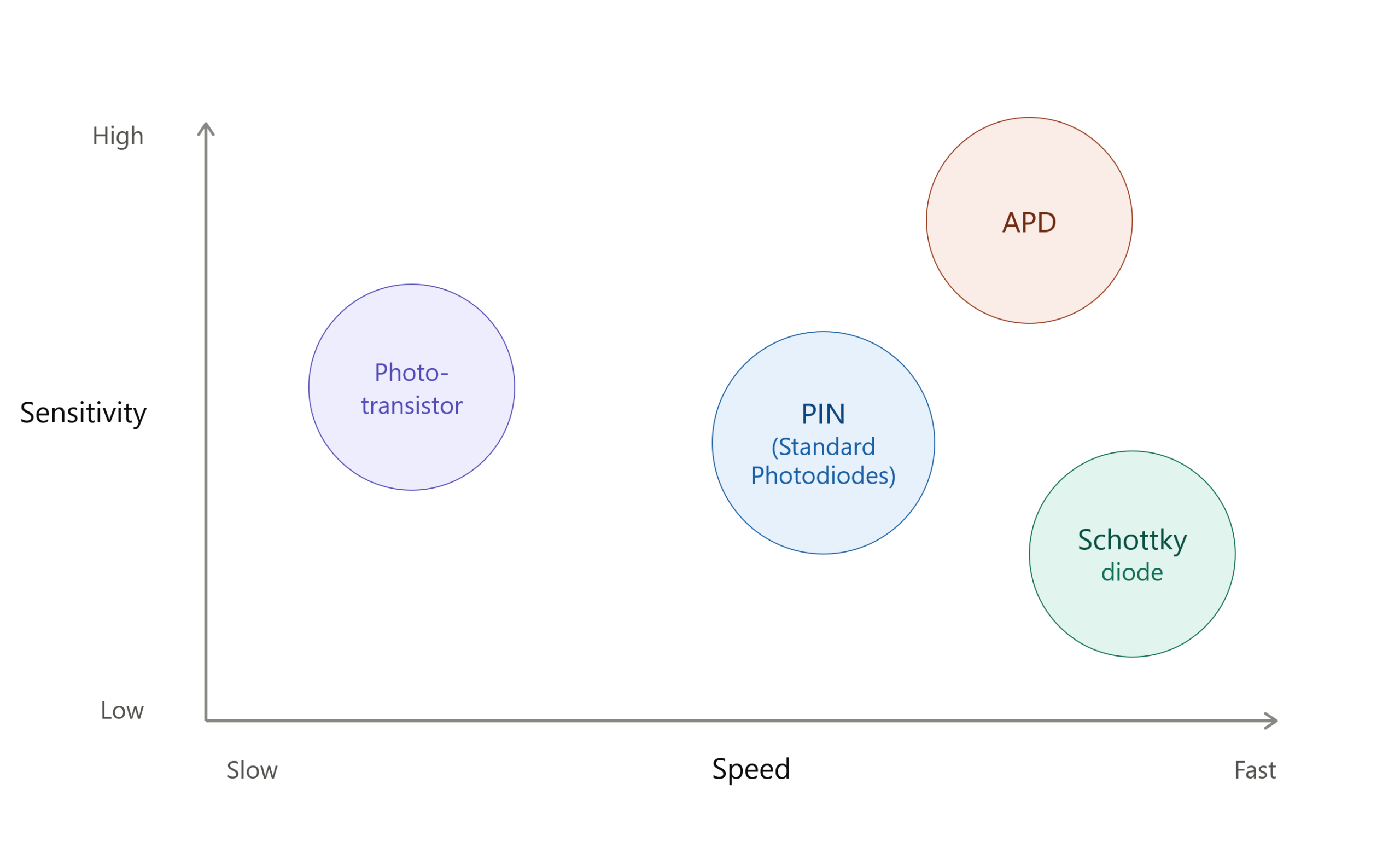 PIN photodiodes insert an intrinsic (undoped) layer between the p-type and n-type regions. This intrinsic layer widens the depletion region without requiring exotic doping profiles, which improves both speed and quantum efficiency. PIN photodiodes are the workhorse detector for telecommunications, industrial sensing, and general-purpose light detection, and they represent most photodiodes deployed in commercial systems today. Our Standard InGaAs Photodiodes are a PIN design built for general-purpose SWIR detection.
Avalanche photodiodes (APDs) apply a much higher reverse bias, high enough to trigger avalanche multiplication. A single absorbed photon can trigger a cascade of secondary electron-hole pairs, producing internal gain before the signal ever reaches an external amplifier. APDs are the detector of choice when incoming light levels are extremely low, as in long-haul fiber optic links, LiDAR, and certain photon-counting applications. The tradeoff is added circuit complexity and a bias voltage that must be carefully regulated and temperature compensated. Our InGaAs Avalanche Photodiodes are built specifically for these low-light, high-gain applications.
Schottky photodiodes use a metal-semiconductor junction rather than a p-n junction. This structure responds to shorter wavelengths, including ultraviolet light, and offers fast response times because there is no minority-carrier storage effect to slow the device down. Schottky photodiodes see use in UV detection and in some high-speed applications where their spectral response fits the need.
Phototransistors combine a photodiode with a transistor to provide built-in current gain. They are slower and less linear than PIN photodiodes. Still, they are also lower in cost and simpler to bias, making them a common choice for basic light-sensing circuits, proximity sensors, and consumer electronics.
Position-Sensing and Specialty Photodiodes
Beyond single-element detectors that measure light intensity, several photodiode families measure where light lands or solve a narrower problem than general-purpose detection.
Quadrant and multi-cell photodiodes divide the active area into separate segments, each wired to its own output. Comparing signals across segments reveals a beam’s position on the detector surface, making these devices the standard choice for laser alignment, beam tracking, and autofocus systems. Our Quadrant Photodiodes and Octo Photodiodes extend this segmented approach to four-cell and eight-cell configurations, respectively.
Tetralateral photodiodes use a continuous active area rather than discrete segments, and they resolve beam position through the ratio of currents collected at electrodes on each edge of the device. This continuous approach delivers smoother position resolution than a segmented detector, and GPD Optoelectronics’ Tetralateral Photodiodes are built for precision alignment and tracking applications where that smoothness matters.
Two-color detectors stack two photodiode junctions tuned to different wavelength bands in a single package, allowing one detector to report intensity at two wavelengths simultaneously rather than requiring two separate optical paths. Our Two-Color Detectors serve spectroscopy and discrimination applications where that dual-band measurement replaces a bulkier optical setup.
Low polarization-dependent loss (low-PDL) InGaAs photodiodes are engineered to keep responsivity consistent regardless of the incoming light’s polarization state, which matters in fiber optic systems where polarization drifts over the length of a link. Our Low-PDL InGaAs Photodiodes address this requirement directly for telecom and optical measurement systems.
Material Systems and Wavelength Range
The semiconductor material used in a photodiode determines its usable wavelength range.
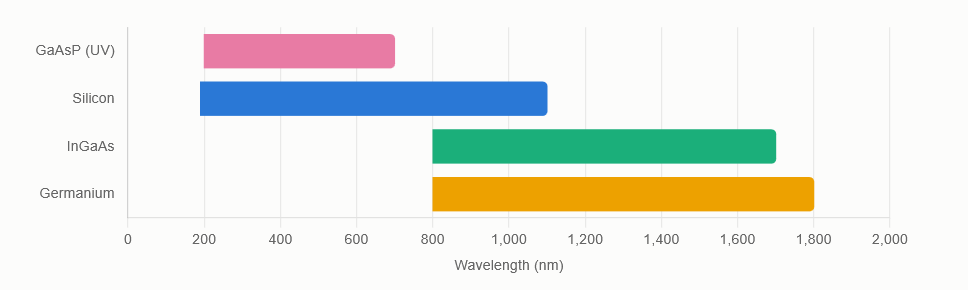
Silicon photodiodes cover roughly 190 nm to 1100 nm, spanning the ultraviolet through the near-infrared and including the visible spectrum. Silicon is the lowest-cost option and the most widely available, and it is the default choice whenever the target wavelength falls within its range.
InGaAs (indium gallium arsenide) photodiodes extend coverage into the shortwave infrared, typically from about 800 nm to 1700 nm, with Extended InGaAs versions reaching further still. InGaAs is the standard material for telecommunications wavelengths (1310 nm and 1550 nm). For SWIR imaging and sensing applications, GPD Optoelectronics offers InGaAs across its full photodiode line, including High-Speed InGaAs photodiodes built for gigahertz-class fiber optic receivers.
Germanium photodiodes cover a similar infrared range to InGaAs at a lower material cost, though they generally show higher dark current and lower speed. Germanium remains a cost-sensitive alternative for applications that don’t require InGaAs performance. Our germanium products serve optical metrology and other budget-conscious infrared measurement applications.
GaAsP and other wide-bandgap materials serve specialized short-wavelength and UV applications where silicon’s response falls off.
Choosing the right material is often the first decision in the selection process, since it immediately narrows the field to devices that can detect the target wavelength. For this reason, GPD Optoelectronics organizes its full photodiode product line by material and architecture, so readers can move from wavelength requirements to a specific part number without leaving the category page.
Applications of Photodiodes
Photodiodes appear across a wide range of industries.
Optical communications rely on photodiodes at the receiving end of every fiber optic link, converting optical signals back into electrical data at speeds ranging from megabits to hundreds of gigabits per second. Medical and bio-sensing devices use photodiodes in pulse oximeters, blood gas analyzers, and various diagnostic instruments that measure light absorption or fluorescence in tissue or fluid samples.
Aerospace and defense systems use photodiodes in laser rangefinders, missile warning systems, free-space optical communication, and other demanding environments that call for radiation-tolerant, ruggedized detectors. Industrial sensing and automation use photodiodes in proximity sensors, laser rangefinders, barcode scanners, and machine vision systems.
Semiconductor manufacturing and metrology depend on photodiodes with well-characterized responsivity curves to measure light intensity precisely during wafer inspection, lithography alignment, and process monitoring. LiDAR and autonomous systems use avalanche photodiodes to detect the faint return signal from a laser pulse reflected off a distant object, often at ranges where the returning light is extremely weak. Consumer electronics use simple photodiodes and phototransistors in ambient light sensors, IR remote receivers, and camera exposure systems.
Choosing the Right Photodiode
Photodiode selection generally follows a sequence. The target wavelength narrows the material-system choice. Required speed and sensitivity narrow the choice to a PIN photodiode, an avalanche photodiode, a Schottky photodiode, or a phototransistor. Active area, package style, and operating temperature range further narrow the field to a specific part number.
Engineers working through this process for the first time often find it useful to work through detailed specification comparisons and a structured selection tool rather than relying on datasheets alone, since small differences in dark current, capacitance, and responsivity curves can meaningfully change performance in a finished design. GPD Optoelectronics’ Photodetector Buyer’s Guide walks through this selection sequence in detail, and the Photodetector Selector tool turns the same logic into four guided questions about wavelength, speed, signal strength, and beam tracking.
Summary
A photodiode converts light into electrical current through a semiconductor junction, operating in either photovoltaic or photoconductive mode depending on the application’s speed and noise requirements. PIN photodiodes, avalanche photodiodes, Schottky photodiodes, and phototransistors each serve a different balance of speed, sensitivity, and cost, and position-sensing and specialty families extend that lineup to beam tracking, dual-wavelength measurement, and polarization-sensitive fiber systems.
Responsivity, dark current, NEP, bandwidth, quantum efficiency, capacitance, active area, and breakdown voltage together describe how a given device will perform in a real circuit. Material choice, whether silicon, InGaAs, germanium, or a specialty compound, sets the usable wavelength range before any of those specifications come into play.
Learn More
- For a deeper look at the SWIR material behind most of today’s telecom and sensing detectors, see the Ultimate Guide to InGaAs Photodiodes.
- For the physics underlying every detector discussed here, see Fundamentals of Light Detection.
- And for a walkthrough of the Buyer’s Guide and Photodetector Selector, ready-made for engineers moving from principles to part number, see our Full Product Line pages.