Picking the Right Photodiode for Your Wavelength Range
Most engineers start with silicon. It’s cheap. It’s familiar. It works great below 1000 nm. Then the wavelength moves. Fiber optic networks run at 1310 nm and 1550 nm. LiDAR systems push into longer near-infrared bands. Spectroscopy depends on SWIR absorption features silicon can’t touch.
At that point, silicon responsivity drops off a cliff. The system needs a different detector material.
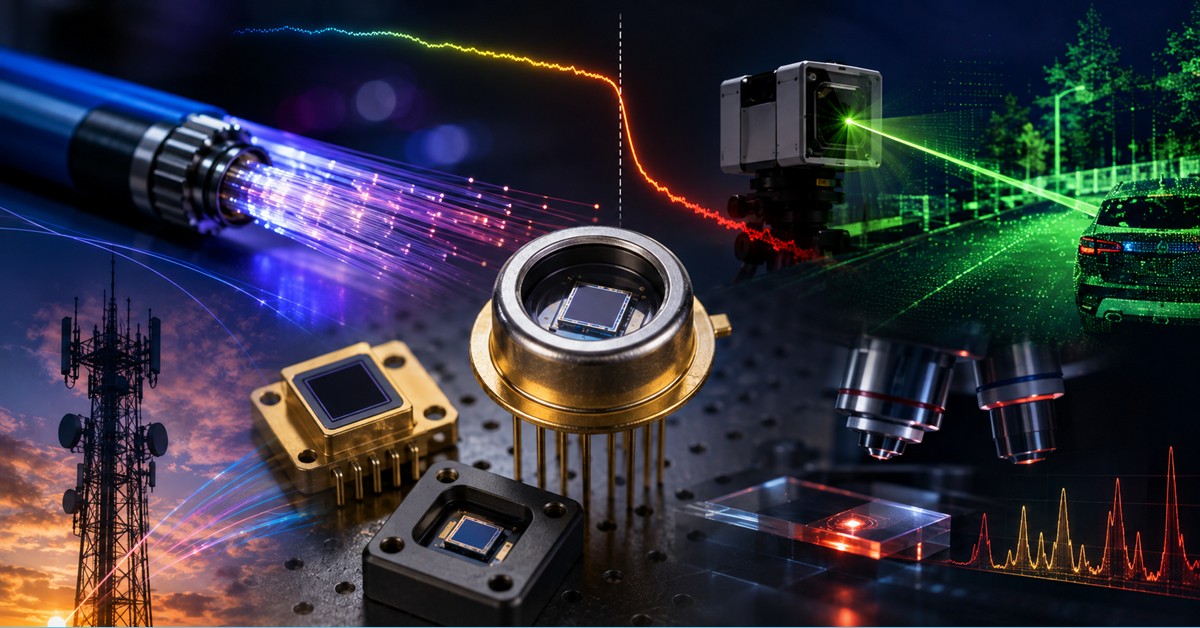
Silicon’s practical detection range ends near 1.1 µm. InGaAs extends useful photodetection from roughly 0.9 to 1.7 µm—and farther with extended-range devices.
Where Silicon Runs Out
Silicon photodiodes are the default starting point for good reason. They’re inexpensive, widely available and reliable for visible-light detection: barcode scanning, laser monitoring, general optical measurement. Below roughly 1000 nm, silicon performs well.
Past that threshold, the physics work against the material. Silicon’s bandgap limits how efficiently it absorbs longer wavelength photons, so responsivity falls sharply as wavelength climbs. A system built around silicon at 1310 nm or 1550 nm won’t just underperform; it may not produce a usable signal at all.
That gap matters because so many important applications live on the wrong side of it. Fiber optic communication runs at 1310 nm and 1550 nm, the bands that support low-loss transmission through optical fiber. Many eye-safer LiDAR and range-finding systems operate at longer near-infrared wavelengths. Spectroscopy and SWIR sensing depend on absorption features that silicon can’t capture efficiently.
InGaAs Fills the Gap
Indium Gallium Arsenide, known as InGaAs, picks up exactly where silicon runs out. InGaAs photodiodes convert near-infrared and short-wave infrared light into electrical current with high sensitivity, fast response and strong performance at 1310 nm and 1550 nm.
Standard InGaAs devices cover roughly 0.9 to 1.7 microns. That range supports 1064 nm lasers, telecom wavelengths and general NIR detection. Extended InGaAs pushes further into the SWIR for chemical analysis, gas detection and environmental monitoring. High-speed InGaAs trades active area for bandwidth, built for the fastest optical signals in telecom and LiDAR.
Each variant solves a different problem. Picking the wrong one adds unnecessary cost or, worse, compromises system performance in ways that don’t show up until integration testing.
Choosing the Right Detector Takes More Than Wavelength
Wavelength range narrows the field. It doesn’t finish the job. Responsivity determines signal strength, how efficiently the detector converts optical power into usable current. Dark current sets the noise floor, the current that flows even with no light present, and it’s often the limiting factor in low-light detection. Bandwidth determines how fast the detector can respond to changing light levels, which is critical for telecom receivers, pulsed lasers and LiDAR. Active area trades light collection against speed: larger detectors simplify alignment but carry more capacitance; smaller detectors respond faster but demand tighter optical alignment.
Package design protects those specs from misalignment or thermal drift. A detector chip with excellent intrinsic performance can still underperform in the field if the package introduces parasitic capacitance or environmental vulnerability.
PIN or APD
A PIN photodiode covers most applications: low noise, stable operation, good linearity, simple biasing. For telecom, power monitoring, spectroscopy and most industrial applications, a PIN detector offers the best balance of performance and integration complexity.
An avalanche photodiode adds internal gain through avalanche multiplication. That gain significantly improves detection in very low-light conditions, making APDs useful for long-range sensing, LiDAR and photon-starved measurements. The tradeoff is system complexity: APDs typically need higher bias voltages, show greater temperature sensitivity and introduce multiplication noise. Bias stability and temperature compensation become critical design considerations, not afterthoughts. Neither architecture is universally better. The right choice depends on the full signal chain, not the detector in isolation.
Built for the System, Not Just the Spec Sheet
Detector selection rarely comes down to one number. Optics, electronics, mechanical constraints, thermal budget, production volume, long-term availability: a real system pulls on all of them at once. GPD Optoelectronics designs and manufactures InGaAs photodiodes for telecom, LiDAR, spectroscopy, aerospace, defense and industrial applications. In-house fabrication and packaging expertise mean engineers can build around actual requirements instead of forcing a design around a generic part.
Read our Ultimate Guide to InGaAs Photodiodes
For the full breakdown, covering PIN vs. APD tradeoffs, quadrant detectors, packaging options and a step-by-step selection framework, read: The Ultimate Guide to InGaAs Photodiodes. Also, answer four questions about your application — wavelength range, response speed, signal strength, and beam tracking — and our Photodetector Selector points you to the detector type best suited for your system.
 https://www.gpd-ir.com/wp-content/uploads/2026/10/Selecting-a-Photodiode-Built-to-Outlast-Your-Aerospace-Mission-Main-Graphic.png
907
1734
GPD Optoelectronics
https://www.gpd-ir.com/wp-content/uploads/2025/12/GPD-Logo-Transparent.png
GPD Optoelectronics2026-10-09 10:30:142026-10-09 11:09:19Selecting a Photodiode Built to Outlast Your Aerospace Mission
https://www.gpd-ir.com/wp-content/uploads/2026/10/Selecting-a-Photodiode-Built-to-Outlast-Your-Aerospace-Mission-Main-Graphic.png
907
1734
GPD Optoelectronics
https://www.gpd-ir.com/wp-content/uploads/2025/12/GPD-Logo-Transparent.png
GPD Optoelectronics2026-10-09 10:30:142026-10-09 11:09:19Selecting a Photodiode Built to Outlast Your Aerospace Mission https://www.gpd-ir.com/wp-content/uploads/2026/09/Introducing-What-is-a-Photodiode-A-Complete-Guide-Blog-Post-Graphic.png
907
1733
GPD Optoelectronics
https://www.gpd-ir.com/wp-content/uploads/2025/12/GPD-Logo-Transparent.png
GPD Optoelectronics2026-09-18 16:51:422026-09-18 16:55:15Introducing What is a Photodiode: A Complete Guide
https://www.gpd-ir.com/wp-content/uploads/2026/08/Picking-the-Right-Photodiode-for-Your-Wavelength-Range.jpg
628
1200
GPD Optoelectronics
https://www.gpd-ir.com/wp-content/uploads/2025/12/GPD-Logo-Transparent.png
GPD Optoelectronics2026-08-28 11:46:432026-10-09 11:08:25Picking the Right Photodiode for Your Wavelength Range
https://www.gpd-ir.com/wp-content/uploads/2026/09/Introducing-What-is-a-Photodiode-A-Complete-Guide-Blog-Post-Graphic.png
907
1733
GPD Optoelectronics
https://www.gpd-ir.com/wp-content/uploads/2025/12/GPD-Logo-Transparent.png
GPD Optoelectronics2026-09-18 16:51:422026-09-18 16:55:15Introducing What is a Photodiode: A Complete Guide
https://www.gpd-ir.com/wp-content/uploads/2026/08/Picking-the-Right-Photodiode-for-Your-Wavelength-Range.jpg
628
1200
GPD Optoelectronics
https://www.gpd-ir.com/wp-content/uploads/2025/12/GPD-Logo-Transparent.png
GPD Optoelectronics2026-08-28 11:46:432026-10-09 11:08:25Picking the Right Photodiode for Your Wavelength Range https://www.gpd-ir.com/wp-content/uploads/2026/07/The-Photonics-Bottleneck-Nobodys-Talking-About-in-the-AI-Buildout-Graphic.jpg
628
1200
GPD Optoelectronics
https://www.gpd-ir.com/wp-content/uploads/2025/12/GPD-Logo-Transparent.png
GPD Optoelectronics2026-07-20 16:26:522026-08-28 11:53:18The Photonics Bottleneck Nobody’s Talking About in the AI Buildout
https://www.gpd-ir.com/wp-content/uploads/2026/07/The-Photonics-Bottleneck-Nobodys-Talking-About-in-the-AI-Buildout-Graphic.jpg
628
1200
GPD Optoelectronics
https://www.gpd-ir.com/wp-content/uploads/2025/12/GPD-Logo-Transparent.png
GPD Optoelectronics2026-07-20 16:26:522026-08-28 11:53:18The Photonics Bottleneck Nobody’s Talking About in the AI Buildout https://www.gpd-ir.com/wp-content/uploads/2026/07/Our-New-Photodetector-Selector-Graphic.jpg
628
1200
GPD Optoelectronics
https://www.gpd-ir.com/wp-content/uploads/2025/12/GPD-Logo-Transparent.png
GPD Optoelectronics2026-05-12 18:07:002026-08-28 11:54:39Our New Photodetector Selector: A Powerful Tool for Engineers
https://www.gpd-ir.com/wp-content/uploads/2026/07/Our-New-Photodetector-Selector-Graphic.jpg
628
1200
GPD Optoelectronics
https://www.gpd-ir.com/wp-content/uploads/2025/12/GPD-Logo-Transparent.png
GPD Optoelectronics2026-05-12 18:07:002026-08-28 11:54:39Our New Photodetector Selector: A Powerful Tool for Engineers https://www.gpd-ir.com/wp-content/uploads/2026/05/Why-the-Cheapest-Photodetector-Is-Usually-the-Most-Expensive-One.jpg
628
1200
GPD Optoelectronics
https://www.gpd-ir.com/wp-content/uploads/2025/12/GPD-Logo-Transparent.png
GPD Optoelectronics2026-05-06 10:06:182026-05-07 14:03:37Why the Cheapest Photodetector Is Usually the Most Expensive One
https://www.gpd-ir.com/wp-content/uploads/2026/05/Why-the-Cheapest-Photodetector-Is-Usually-the-Most-Expensive-One.jpg
628
1200
GPD Optoelectronics
https://www.gpd-ir.com/wp-content/uploads/2025/12/GPD-Logo-Transparent.png
GPD Optoelectronics2026-05-06 10:06:182026-05-07 14:03:37Why the Cheapest Photodetector Is Usually the Most Expensive One https://www.gpd-ir.com/wp-content/uploads/2026/03/Satellite-2026-Graphic.jpg
628
1200
GPD Optoelectronics
https://www.gpd-ir.com/wp-content/uploads/2025/12/GPD-Logo-Transparent.png
GPD Optoelectronics2026-03-01 19:18:102026-08-17 14:31:58Satellite 2026 in Washington, D.C., March 23-26
https://www.gpd-ir.com/wp-content/uploads/2026/03/Satellite-2026-Graphic.jpg
628
1200
GPD Optoelectronics
https://www.gpd-ir.com/wp-content/uploads/2025/12/GPD-Logo-Transparent.png
GPD Optoelectronics2026-03-01 19:18:102026-08-17 14:31:58Satellite 2026 in Washington, D.C., March 23-26 https://www.gpd-ir.com/wp-content/uploads/2026/01/SPIE-Photonics-West-2026.jpg
628
1200
GPD Optoelectronics
https://www.gpd-ir.com/wp-content/uploads/2025/12/GPD-Logo-Transparent.png
GPD Optoelectronics2026-01-22 23:52:102026-04-02 09:24:26Photonics West 2026: San Francisco, January 20-22
https://www.gpd-ir.com/wp-content/uploads/2026/01/SPIE-Photonics-West-2026.jpg
628
1200
GPD Optoelectronics
https://www.gpd-ir.com/wp-content/uploads/2025/12/GPD-Logo-Transparent.png
GPD Optoelectronics2026-01-22 23:52:102026-04-02 09:24:26Photonics West 2026: San Francisco, January 20-22 https://www.gpd-ir.com/wp-content/uploads/2025/12/Digikey-Graphic-1.jpg
628
1200
GPD Optoelectronics
https://www.gpd-ir.com/wp-content/uploads/2025/12/GPD-Logo-Transparent.png
GPD Optoelectronics2025-12-19 09:00:212026-08-17 14:42:33GPD Optoelectronics Announces Global Availability of Photodiodes on DigiKey
https://www.gpd-ir.com/wp-content/uploads/2025/12/Digikey-Graphic-1.jpg
628
1200
GPD Optoelectronics
https://www.gpd-ir.com/wp-content/uploads/2025/12/GPD-Logo-Transparent.png
GPD Optoelectronics2025-12-19 09:00:212026-08-17 14:42:33GPD Optoelectronics Announces Global Availability of Photodiodes on DigiKey https://www.gpd-ir.com/wp-content/uploads/2025/11/GPD-Optoelectronics-Announces-Launch-of-Multi-Cell-Photoreceiver-Development-Kit-Ahead-of-Space-Tech-Expo-Europe-202.jpg
628
1200
GPD Optoelectronics
https://www.gpd-ir.com/wp-content/uploads/2025/12/GPD-Logo-Transparent.png
GPD Optoelectronics2025-11-06 09:00:412026-04-01 16:12:09GPD Optoelectronics Announces Launch of Multi-Cell Photoreceiver Development Kit Ahead of Space Tech Expo Europe 2025
https://www.gpd-ir.com/wp-content/uploads/2025/11/GPD-Optoelectronics-Announces-Launch-of-Multi-Cell-Photoreceiver-Development-Kit-Ahead-of-Space-Tech-Expo-Europe-202.jpg
628
1200
GPD Optoelectronics
https://www.gpd-ir.com/wp-content/uploads/2025/12/GPD-Logo-Transparent.png
GPD Optoelectronics2025-11-06 09:00:412026-04-01 16:12:09GPD Optoelectronics Announces Launch of Multi-Cell Photoreceiver Development Kit Ahead of Space Tech Expo Europe 2025 https://www.gpd-ir.com/wp-content/uploads/2026/03/GPD-Optoelectronics-Corp.-Awarded-14.5M-Contract-to-Advance-Rugged-Optical-Receiver-Technology.jpg
628
1200
GPD Optoelectronics
https://www.gpd-ir.com/wp-content/uploads/2025/12/GPD-Logo-Transparent.png
GPD Optoelectronics2025-10-23 09:05:202026-04-02 09:12:36GPD Optoelectronics Corp. Awarded $14.5M Contract to Advance Rugged Optical Receiver Technology
https://www.gpd-ir.com/wp-content/uploads/2026/03/GPD-Optoelectronics-Corp.-Awarded-14.5M-Contract-to-Advance-Rugged-Optical-Receiver-Technology.jpg
628
1200
GPD Optoelectronics
https://www.gpd-ir.com/wp-content/uploads/2025/12/GPD-Logo-Transparent.png
GPD Optoelectronics2025-10-23 09:05:202026-04-02 09:12:36GPD Optoelectronics Corp. Awarded $14.5M Contract to Advance Rugged Optical Receiver TechnologyUltimate Guide to InGaAs Photodiodes
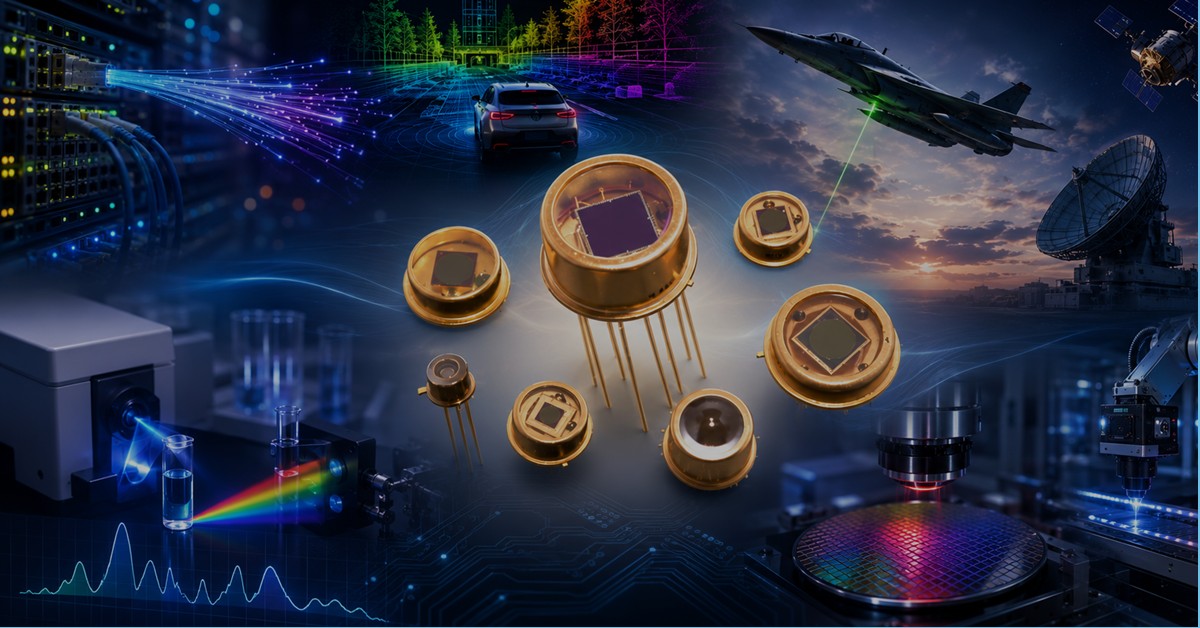
InGaAs photodiodes deliver high sensitivity, fast response, and reliable performance across near-infrared and short-wave infrared wavelengths where silicon falls short. This Ultimate Guide to InGaAs Photodiodes covers how they work, how standard, extended, and high-speed variants differ, and how to select the right detector for telecom, LiDAR, spectroscopy, bio-sensing, and industrial applications.

