The Photonics Bottleneck Nobody’s Talking About in the AI Buildout
Every headline about the AI infrastructure boom centers on GPUs. OpenAI’s Stargate initiative alone carries a price tag near 500 billion dollars, and hyperscalers across the country are breaking ground on new data center capacity at a pace the industry has never seen.
But underneath the compute story sits a quieter bottleneck: getting data into and out of those chips fast enough to keep them fed.
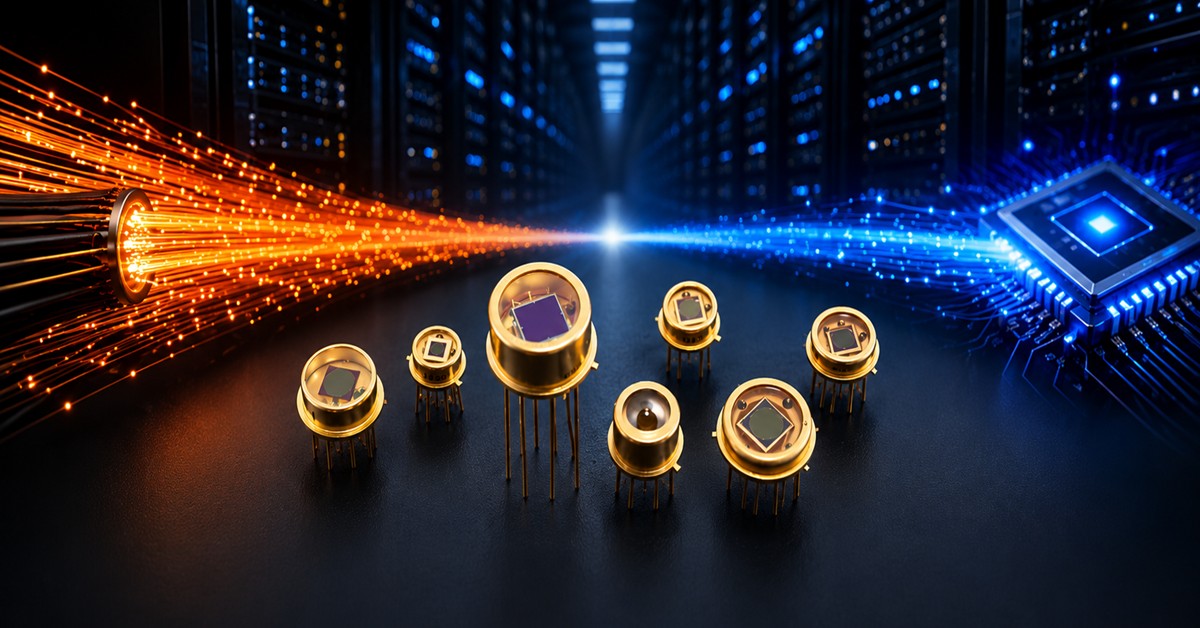
Copper wiring handled that job for decades. It cannot handle it anymore. High-frequency electrical signals degrade quickly over copper, throwing off heat and burning energy that AI clusters can’t spare. That’s why the industry has already shifted to optical interconnects, moving data as light through fiber rather than electrons through wire.
Why This Is Suddenly Urgent
800G network architecture is actively rolling out in data centers today, and 1.6T is moving fast through standardization and early productization. That timeline compresses the window for getting photodetection right. At every one of those speeds, a photodiode has to sit at the conversion point, turning incoming light back into an electrical signal a server’s processor can use. Get that conversion wrong, or too slow, or too noisy, and the rest of the network’s speed doesn’t matter.
Why Silicon Can’t Do the Job
Silicon runs almost everything in modern computing, but it has a hard physical limit here. Fiber-optic networks run on near-infrared wavelengths, mainly around 1310 nm and 1550 nm, and silicon is transparent to anything longer than 1100 nm. Light at those wavelengths passes straight through a silicon chip without being absorbed at all. That’s why the industry has standardized on two alternative materials, Germanium and Indium Gallium Arsenide (InGaAs), each suited to a different part of the network.
Two Materials, Two Very Different Jobs
Germanium is the cost-efficient workhorse for short-reach links inside the rack. InGaAs takes over where speed and signal integrity can’t be compromised: spine-leaf switches, data center interconnects, and the ultra-fast links AI training workloads depend on to move data between GPU clusters with near-zero latency.
We go deep on the physics behind that divide, exactly where each material deploys across the data center architecture, and how photodetection is getting built into every layer of the optical pathway as 1.6T moves toward deployment, in our full resource article: InGaAs and Germanium Photodiodes: Critical Infrastructure for Data Center Buildout Plans.
The Bottom Line on AI Data Centers
The AI data center buildout isn’t just a story about adding processors. It’s a story about building the physical pathways fast enough to keep those processors busy. Germanium and InGaAs photodiodes are doing the unglamorous, essential work of making that possible, not as a footnote to the compute story, but as one of its foundational components. For the full technical breakdown, please read: InGaAs and Germanium Photodiodes: Critical Infrastructure for Data Center Buildout Plans.
 https://www.gpd-ir.com/wp-content/uploads/2026/10/Selecting-a-Photodiode-Built-to-Outlast-Your-Aerospace-Mission-Main-Graphic.png
907
1734
GPD Optoelectronics
https://www.gpd-ir.com/wp-content/uploads/2025/12/GPD-Logo-Transparent.png
GPD Optoelectronics2026-10-09 10:30:142026-10-09 11:09:19Selecting a Photodiode Built to Outlast Your Aerospace Mission
https://www.gpd-ir.com/wp-content/uploads/2026/10/Selecting-a-Photodiode-Built-to-Outlast-Your-Aerospace-Mission-Main-Graphic.png
907
1734
GPD Optoelectronics
https://www.gpd-ir.com/wp-content/uploads/2025/12/GPD-Logo-Transparent.png
GPD Optoelectronics2026-10-09 10:30:142026-10-09 11:09:19Selecting a Photodiode Built to Outlast Your Aerospace Mission https://www.gpd-ir.com/wp-content/uploads/2026/09/Introducing-What-is-a-Photodiode-A-Complete-Guide-Blog-Post-Graphic.png
907
1733
GPD Optoelectronics
https://www.gpd-ir.com/wp-content/uploads/2025/12/GPD-Logo-Transparent.png
GPD Optoelectronics2026-09-18 16:51:422026-09-18 16:55:15Introducing What is a Photodiode: A Complete Guide
https://www.gpd-ir.com/wp-content/uploads/2026/09/Introducing-What-is-a-Photodiode-A-Complete-Guide-Blog-Post-Graphic.png
907
1733
GPD Optoelectronics
https://www.gpd-ir.com/wp-content/uploads/2025/12/GPD-Logo-Transparent.png
GPD Optoelectronics2026-09-18 16:51:422026-09-18 16:55:15Introducing What is a Photodiode: A Complete Guide https://www.gpd-ir.com/wp-content/uploads/2026/08/Picking-the-Right-Photodiode-for-Your-Wavelength-Range.jpg
628
1200
GPD Optoelectronics
https://www.gpd-ir.com/wp-content/uploads/2025/12/GPD-Logo-Transparent.png
GPD Optoelectronics2026-08-28 11:46:432026-10-09 11:08:25Picking the Right Photodiode for Your Wavelength Range
https://www.gpd-ir.com/wp-content/uploads/2026/07/The-Photonics-Bottleneck-Nobodys-Talking-About-in-the-AI-Buildout-Graphic.jpg
628
1200
GPD Optoelectronics
https://www.gpd-ir.com/wp-content/uploads/2025/12/GPD-Logo-Transparent.png
GPD Optoelectronics2026-07-20 16:26:522026-08-28 11:53:18The Photonics Bottleneck Nobody’s Talking About in the AI Buildout
https://www.gpd-ir.com/wp-content/uploads/2026/08/Picking-the-Right-Photodiode-for-Your-Wavelength-Range.jpg
628
1200
GPD Optoelectronics
https://www.gpd-ir.com/wp-content/uploads/2025/12/GPD-Logo-Transparent.png
GPD Optoelectronics2026-08-28 11:46:432026-10-09 11:08:25Picking the Right Photodiode for Your Wavelength Range
https://www.gpd-ir.com/wp-content/uploads/2026/07/The-Photonics-Bottleneck-Nobodys-Talking-About-in-the-AI-Buildout-Graphic.jpg
628
1200
GPD Optoelectronics
https://www.gpd-ir.com/wp-content/uploads/2025/12/GPD-Logo-Transparent.png
GPD Optoelectronics2026-07-20 16:26:522026-08-28 11:53:18The Photonics Bottleneck Nobody’s Talking About in the AI Buildout https://www.gpd-ir.com/wp-content/uploads/2026/07/Our-New-Photodetector-Selector-Graphic.jpg
628
1200
GPD Optoelectronics
https://www.gpd-ir.com/wp-content/uploads/2025/12/GPD-Logo-Transparent.png
GPD Optoelectronics2026-05-12 18:07:002026-08-28 11:54:39Our New Photodetector Selector: A Powerful Tool for Engineers
https://www.gpd-ir.com/wp-content/uploads/2026/07/Our-New-Photodetector-Selector-Graphic.jpg
628
1200
GPD Optoelectronics
https://www.gpd-ir.com/wp-content/uploads/2025/12/GPD-Logo-Transparent.png
GPD Optoelectronics2026-05-12 18:07:002026-08-28 11:54:39Our New Photodetector Selector: A Powerful Tool for Engineers https://www.gpd-ir.com/wp-content/uploads/2026/05/Why-the-Cheapest-Photodetector-Is-Usually-the-Most-Expensive-One.jpg
628
1200
GPD Optoelectronics
https://www.gpd-ir.com/wp-content/uploads/2025/12/GPD-Logo-Transparent.png
GPD Optoelectronics2026-05-06 10:06:182026-05-07 14:03:37Why the Cheapest Photodetector Is Usually the Most Expensive One
https://www.gpd-ir.com/wp-content/uploads/2026/05/Why-the-Cheapest-Photodetector-Is-Usually-the-Most-Expensive-One.jpg
628
1200
GPD Optoelectronics
https://www.gpd-ir.com/wp-content/uploads/2025/12/GPD-Logo-Transparent.png
GPD Optoelectronics2026-05-06 10:06:182026-05-07 14:03:37Why the Cheapest Photodetector Is Usually the Most Expensive One https://www.gpd-ir.com/wp-content/uploads/2026/03/Satellite-2026-Graphic.jpg
628
1200
GPD Optoelectronics
https://www.gpd-ir.com/wp-content/uploads/2025/12/GPD-Logo-Transparent.png
GPD Optoelectronics2026-03-01 19:18:102026-08-17 14:31:58Satellite 2026 in Washington, D.C., March 23-26
https://www.gpd-ir.com/wp-content/uploads/2026/03/Satellite-2026-Graphic.jpg
628
1200
GPD Optoelectronics
https://www.gpd-ir.com/wp-content/uploads/2025/12/GPD-Logo-Transparent.png
GPD Optoelectronics2026-03-01 19:18:102026-08-17 14:31:58Satellite 2026 in Washington, D.C., March 23-26 https://www.gpd-ir.com/wp-content/uploads/2026/01/SPIE-Photonics-West-2026.jpg
628
1200
GPD Optoelectronics
https://www.gpd-ir.com/wp-content/uploads/2025/12/GPD-Logo-Transparent.png
GPD Optoelectronics2026-01-22 23:52:102026-04-02 09:24:26Photonics West 2026: San Francisco, January 20-22
https://www.gpd-ir.com/wp-content/uploads/2026/01/SPIE-Photonics-West-2026.jpg
628
1200
GPD Optoelectronics
https://www.gpd-ir.com/wp-content/uploads/2025/12/GPD-Logo-Transparent.png
GPD Optoelectronics2026-01-22 23:52:102026-04-02 09:24:26Photonics West 2026: San Francisco, January 20-22 https://www.gpd-ir.com/wp-content/uploads/2025/12/Digikey-Graphic-1.jpg
628
1200
GPD Optoelectronics
https://www.gpd-ir.com/wp-content/uploads/2025/12/GPD-Logo-Transparent.png
GPD Optoelectronics2025-12-19 09:00:212026-08-17 14:42:33GPD Optoelectronics Announces Global Availability of Photodiodes on DigiKey
https://www.gpd-ir.com/wp-content/uploads/2025/12/Digikey-Graphic-1.jpg
628
1200
GPD Optoelectronics
https://www.gpd-ir.com/wp-content/uploads/2025/12/GPD-Logo-Transparent.png
GPD Optoelectronics2025-12-19 09:00:212026-08-17 14:42:33GPD Optoelectronics Announces Global Availability of Photodiodes on DigiKey https://www.gpd-ir.com/wp-content/uploads/2025/11/GPD-Optoelectronics-Announces-Launch-of-Multi-Cell-Photoreceiver-Development-Kit-Ahead-of-Space-Tech-Expo-Europe-202.jpg
628
1200
GPD Optoelectronics
https://www.gpd-ir.com/wp-content/uploads/2025/12/GPD-Logo-Transparent.png
GPD Optoelectronics2025-11-06 09:00:412026-04-01 16:12:09GPD Optoelectronics Announces Launch of Multi-Cell Photoreceiver Development Kit Ahead of Space Tech Expo Europe 2025
https://www.gpd-ir.com/wp-content/uploads/2025/11/GPD-Optoelectronics-Announces-Launch-of-Multi-Cell-Photoreceiver-Development-Kit-Ahead-of-Space-Tech-Expo-Europe-202.jpg
628
1200
GPD Optoelectronics
https://www.gpd-ir.com/wp-content/uploads/2025/12/GPD-Logo-Transparent.png
GPD Optoelectronics2025-11-06 09:00:412026-04-01 16:12:09GPD Optoelectronics Announces Launch of Multi-Cell Photoreceiver Development Kit Ahead of Space Tech Expo Europe 2025 https://www.gpd-ir.com/wp-content/uploads/2026/03/GPD-Optoelectronics-Corp.-Awarded-14.5M-Contract-to-Advance-Rugged-Optical-Receiver-Technology.jpg
628
1200
GPD Optoelectronics
https://www.gpd-ir.com/wp-content/uploads/2025/12/GPD-Logo-Transparent.png
GPD Optoelectronics2025-10-23 09:05:202026-04-02 09:12:36GPD Optoelectronics Corp. Awarded $14.5M Contract to Advance Rugged Optical Receiver Technology
https://www.gpd-ir.com/wp-content/uploads/2026/03/GPD-Optoelectronics-Corp.-Awarded-14.5M-Contract-to-Advance-Rugged-Optical-Receiver-Technology.jpg
628
1200
GPD Optoelectronics
https://www.gpd-ir.com/wp-content/uploads/2025/12/GPD-Logo-Transparent.png
GPD Optoelectronics2025-10-23 09:05:202026-04-02 09:12:36GPD Optoelectronics Corp. Awarded $14.5M Contract to Advance Rugged Optical Receiver Technology
